VIctory family · AMD · ray tracing
avatarmanz GTA 6 PC port: VIctory-7900XTX progress
VIctory-7900XTX was avatarmanz's fork of VIctory, aimed at GTA 6's Series X version at 4K with ray tracing on an AMD Radeon RX 7900 XTX. Its last README reported about 9 to 10 fps with ray tracing and up to 25 fps at 1080p without it, walking through a city street. As of November 28, 2026 the repository is no longer available on GitHub.
Removed · removed from GitHub; last README of Nov 26, 2026 reported stage 5 of 6
- Stage
- Removed (last README: In control)
- Repository
- avatarmanz/VIctory-7900XTX
- Based on
- VIctory via fxceless/victory-fork
- Licence
- GPL-3.0-or-later
- Frame rate
- Last README: 9–10 fps ray tracing on; 16–25 fps off
- Tested on
- i9-12900K + RX 7900 XTX, 64 GB RAM
- Checked
- Nov 28, 2026
What avatarmanz's GTA 6 PC port is
VIctory-7900XTX was a fork of VIctory, the compatibility layer that runs the Xbox Series build of GTA 6 natively on Windows from files the user supplies. It started from Hyphen's victory-fork and was published by the GitHub account avatarmanz (sometimes searched as "avatar manz gta vi"). The repository was created on November 25, 2026 and passed 1,800 stars and 580 forks within two days. As of November 28, 2026 the repository and its README return not found on GitHub.
Its goal was narrower than most forks: GTA 6's Series X version at 4K output (drawn at 1440p) with ray tracing on, looking the way it does on the Xbox, on a Radeon RX 7900 XTX first. The README set the order plainly: a correct picture, then 30 fps or more with ray tracing, then smaller PCs with 32 GB and later 16 GB of RAM.
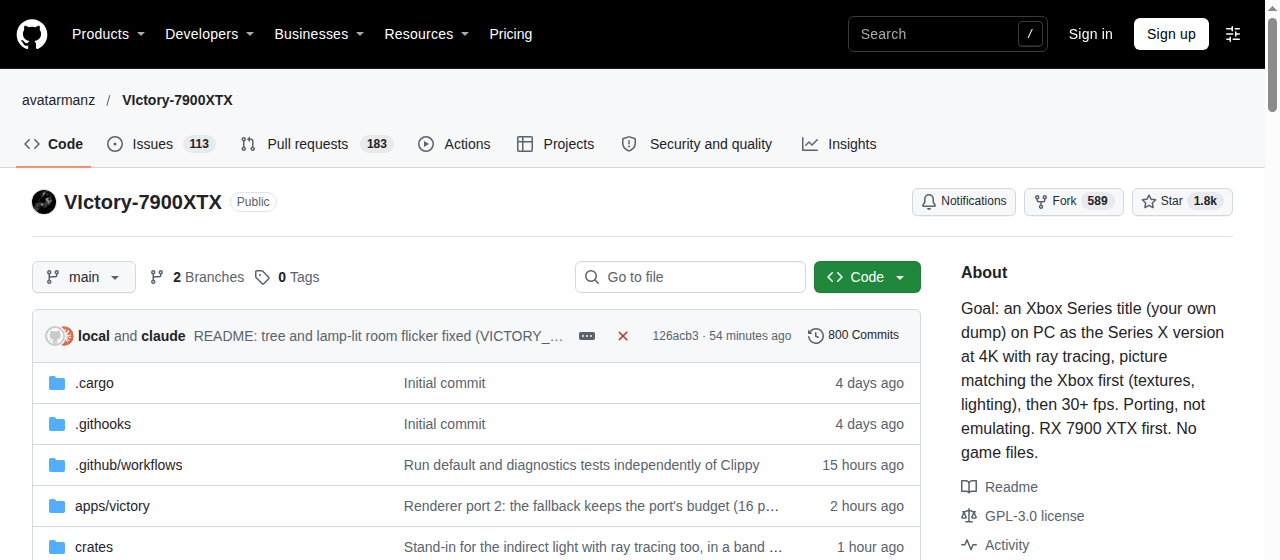
The avatarmanz/VIctory-7900XTX GitHub page on November 26, 2026. The project published no demo images, so this is a screenshot of the repository itself.
avatarmanz GTA 6 PC port progress
The last README this tracker read, dated November 26, 2026, reported runs of 270 seconds in a city street, first standing still and then walking and turning the camera. It was tested on one machine: Windows 11, an Intel i9-12900K, 64 GB of RAM and a Radeon RX 7900 XTX.
| Version | Standing | Walking | RAM |
|---|---|---|---|
| Series X, 4K drawn at 1440p, ray tracing on (the goal) | 10 fps (99 ms) | about 9 fps (110 ms) | 45 GB |
| Series X, 4K drawn at 1440p, ray tracing off | 20 fps (49 ms) | about 16 fps (62 ms) | 45 GB |
| Series X, 1080p output, ray tracing off | 25 fps (40 ms) | about 23 fps (43 ms) | 42 GB |
| Series S, ray tracing off | 23 fps (43 ms) | about 16 fps (64 ms) | 37 GB |
The same scenes ran at 280 ms a frame (under 4 fps) three days earlier. The README said the limit then was the single thread that sends the game's work to the graphics card, at about 40 ms a frame, while the card itself needed about 36 ms.
On this tracker's scale that was In control: the player walked through the world on real hardware. It never reached Playable, because no mode held 25 fps while moving and the README listed open visual faults. With the repository gone, the project now counts as Removed.
What still breaks
The last README listed these open faults:
- Models and textures stay at their lowest detail for a long time while the game streams, worst in the intro. The game paces its streaming by its own frames, so at 10 fps it loads about three times slower than at 30.
- Ray-traced data for moving objects is partly corrupt.
- Trees, signs and far objects flicker in the distance in some places.
- Lighting is too bright or too dark after walking indoors until the game has run for a while.
- The first run of a new build stutters while the driver builds pipelines.
Two faults were fixed on November 26: trees and palms dropping out for a few frames, and lamp-lit rooms swinging between too dark and too bright. Rooms lit only by bounced light were no longer black with ray tracing on.
How VIctory-7900XTX worked: porting, not emulating
The README called its approach porting, not emulating. Instead of having the layer watch and copy the console's shared memory every frame, it patched the game's renderer so it behaves like a PC renderer. Five of these renderer patches could be switched on one by one while they were tested. Shaders were translated ahead of time into a store kept between builds; the README counted 25,790 of the game's 25,985 shaders translating, the rest being unused.
Like other fast VIctory forks, it moved work off the game's own threads: eight worker threads translated graphics commands, a separate thread prepared GPU submissions, and textures uploaded on their own copy queue.
Who avatarmanz built on
The README credited a chain of other projects: VIctory by Marvisak for the loader and shader recompiler, Hyphen's victory-fork as its starting point, DexNom's ray-tracing fixes, Belobug's AMD fork for its ambient-light idea and pipeline workers, myokex's victory-amd and others. It also said the fork's changes were made with an AI coding assistant. XCL was read for comparison, but none of its code was included.
What you need to run it
Windows 10/11 x64, a CPU with AVX2, a Direct3D 12 graphics card with Shader Model 6.6 and mesh shaders, the Rust toolchain and MSVC build tools, and your own copy of the game. The repository stated it contained no game files, code or assets, and recommended 64 GB of RAM. Compare the projects still online on can I run the GTA 6 PC port, or follow GitHub activity on the GTA 6 PC port progress tracker.